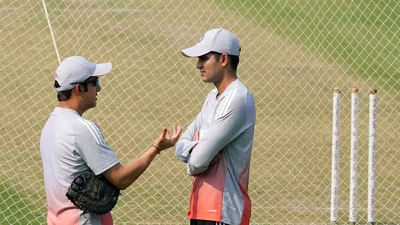
Before a match, cameras often show captains studying the strip, pointing at patches of grass and looking closely at cracks. They are trying to answer one question: how might this surface change the contest between bat and ball?
To learn how to read a cricket pitch, start with grass, moisture, hardness and wear. Treat them as clues to test during play. A photograph or a quick inspection cannot reveal everything happening beneath the surface.
What grass can tell you
A covering of live green grass can help seam movement, particularly when moisture is present. Look at how evenly it covers the areas where bowlers are likely to land the ball. Patchy grass can contribute to inconsistent behaviour.
Avoid assuming that every green pitch will produce extravagant movement. Grass is one part of the surface, alongside the soil, preparation and moisture. Also separate swing from seam bowling: swing happens in the air; seam movement follows contact with the pitch.
Why moisture and hardness belong together
A dry-looking top can conceal moisture underneath. A soft surface can absorb more of the ball’s energy, while a well-compacted, firm surface can help it retain pace. Very dry pitches can also lose bounce. Colour alone is therefore an unreliable shortcut.
The Grounds Management Association’s pitch guidance explains how hardness, smoothness and friction work together. It also identifies uneven drying and compaction as possible causes of a two-paced surface.
What cracks and rough patches mean
A crack is a reason to look more closely, rather than an automatic prediction of turn. Consider whether cracks are fine and stable or wider with loose edges, and whether they lie in the likely landing areas. Unstable cracks can contribute to variable bounce.
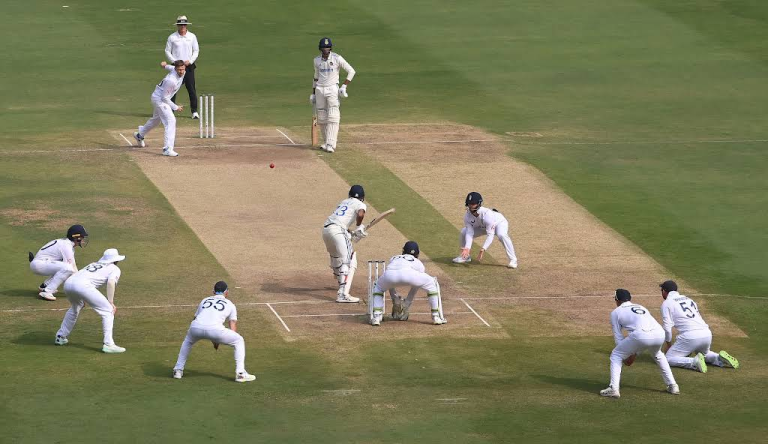
Dry, worn and rough areas can give spin bowlers more assistance. Their usefulness depends on the delivery and where the bowler can land it. For an introduction to the different directions of turn, read our guide to off spin and leg spin.
Keep the pitch separate from the weather
Rain, drying conditions and time under covers add context to an inspection. Ask what happened before the surface was uncovered, rather than relying only on the weather at the toss.
Do not treat humidity as a guarantee of swing. An ICC report on swing research describes tests that found no significant humidity effect. Damp soil and moisture in the air are different things.
For evening matches, also consider the possibility of a wet ball and outfield. Our guide to the dew factor in cricket explains why that matters for the bowling side.
How should the pitch affect the toss?
The Magnus Sports pitch-reading guide outlines familiar starting points: early assistance on a green surface and potential deterioration on a dry one. Use those as possibilities, then weigh your team’s strengths and the match format.
For example, a captain might accept a difficult opening spell if batting first avoids a harder final innings. In a short match, the immediate conditions and chasing prospects may carry more weight. No single visual feature settles the decision.
A quick checklist before the first ball
- Is the grass live, sparse or uneven?
- Does the surface look consistently prepared, or are there contrasting patches?
- Where are the cracks and worn areas relative to a good length?
- What can the grounds staff tell you about preparation and recent rain?
- Is the surface fresh or previously used?
- Which assumptions can you check during the opening overs?
Let the opening overs update your reading
Watch deliveries of similar length: do they reach the wicketkeeper at a consistent height? Are batters early into their shots? Is sideways movement happening before or after the bounce? These observations help turn an initial guess into a useful match assessment.
Reading a pitch is an ongoing process. Make a sensible prediction before the toss, then adjust your understanding as the ball shows you how the surface is playing.
Frequently asked questions
1. How do you read a cricket pitch before a match?
Look at grass coverage, visible moisture, cracks and worn areas together. Ask about recent preparation and rain, then compare your expectations with the ball’s behaviour during the opening overs.
2. Does a green pitch always help fast bowlers?
Live grass and moisture can assist seam movement, but appearance alone cannot guarantee it. Surface firmness, preparation, the ball and the bowler’s skill all matter.
3. Do cracks mean a pitch will turn?
Not necessarily. Their location and stability matter. Rough, worn areas can assist spin, while unstable cracks may contribute to unpredictable bounce.
4. Is a dry pitch always good for batting?
No. A firm, even surface can offer reliable bounce, but a dry surface that is loose, worn or deteriorating may make batting harder.
5. Should you bat or bowl first on a green pitch?
There is no automatic answer. Weigh possible early seam movement against how conditions may change, the match format and your team’s strengths.
6. Does humidity make a cricket ball swing?
Humidity alone is not a reliable predictor of swing. The ICC research report linked above describes tests that found no significant humidity effect; moisture in the pitch is a separate consideration.