This image is not owned by Behind the Stump. Rights belong to the respective copyright owner.
Reverse swing in cricket is movement through the air in the opposite direction to conventional swing for a comparable seam orientation. It is often associated with a worn ball and can make an established batter reassess a delivery that initially looks familiar.
It is not another name for inswing, and it is not movement caused by the ball landing on the seam. Understanding those distinctions is more useful than assuming that every sharply bending old-ball delivery must be reversing.
Conventional swing vs reverse swing: the basic difference
Both are aerodynamic movement before the bounce. In conventional swing the ball generally moves towards the direction of an angled seam. Under suitable reverse-swing conditions, the relationship reverses. On a worn ball with contrasting surfaces, reverse swing is commonly described as movement towards the smoother side.
Seam orientation, speed and surface condition interact. Rabindra Mehta and Demmis Koga’s cricket-ball aerodynamics research explains why roughness changes the speed conditions at which reversal can occur. There is no universal over number at which a ball switches modes.
For the wider distinction between movement in the air and off the pitch, start with our swing versus seam bowling guide. A delivery can show both, so one label need not explain its entire path.
Why is reverse swing associated with an older ball?
Play changes a ball’s surface and seam. Suitable wear can make reverse swing possible at speeds where a newer ball would behave differently. However, ball age is a clue rather than a guarantee; a worn ball can also stop offering useful movement.
Dry, abrasive conditions may accelerate wear, while a wet ball presents different handling problems. The bowler still needs an effective release. Our Dukes, Kookaburra and SG comparison provides context on ball construction without treating any brand as a promise of reverse swing.
For spectators, this is a reason to follow the spell as a whole. A commentator mentioning the ball’s age provides context, but the next replay still needs to show what the delivery actually did.
Is reverse swing always an inswinger?
No. Inswing and outswing describe movement relative to the batter. Conventional and reverse describe the aerodynamic behaviour. A reverse-swinging delivery may move into or away from the batter depending on its presentation.
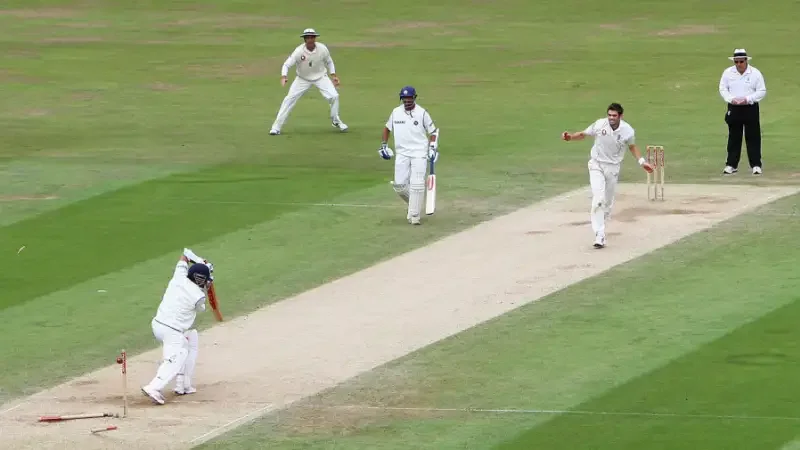
This distinction matters when discussing a dismissal. Saying “the ball came back in” describes the result; it does not by itself establish the type of swing. The camera angle, release and ball condition help support a more specific explanation.
One example: why a familiar line can become dangerous
Imagine a fictional right-handed batter facing a fast bowler late in an innings. The batter has been judging deliveries near off stump and deciding whether to defend or leave. A fuller ball begins on a similar apparent line but curves inward before reaching the pitch.
The batter now has to adjust both the bat’s path and the original judgement of line. If the shot is late, a gap between bat and pad may matter. If the ball hits the pad, any appeal still requires the usual LBW checks; swing alone never establishes that the batter is out.
This example shows the tactical threat of changing movement. It is not proof that every full inswinging ball is reverse swing, or that an older ball makes defending impossible.
Is reverse swing legal?
Yes. Reverse swing itself is a legitimate bowling skill. Illegal interference with the ball is a separate issue. Natural wear and permitted maintenance should not be confused with deliberately damaging the surface.
MCC Law 41 on unfair play sets out permitted ball care and prohibits other actions that unfairly alter its condition. Scratching the surface or applying an artificial substance is not a legitimate shortcut. Competition playing conditions can modify the Laws, so precise procedures need checking for the match concerned.
What should you look for in a replay?
First separate the angle of the bowler’s approach from an actual curved flight path. Then watch whether the change occurs before or after pitching. A delivery travelling diagonally across the batter is not necessarily swinging at all.
Next consider the available evidence. A close-up may show seam presentation; another replay may show curvature more clearly. If the broadcast does not reveal the ball’s condition, describing the movement is more reliable than confidently naming its mechanism.
Finally, watch the batter’s response. A late correction, an inside edge or a missed leave can explain the delivery’s practical effect even when the exact aerodynamic classification remains uncertain.
Reverse swing in cricket FAQs
These answers clarify reverse swing in cricket, conventional swing and common claims about old-ball movement.
1. Does every old ball reverse swing?
No. Age alone does not establish the necessary combination of condition, speed and presentation.
2. Is reverse swing the same as seam movement?
No. Swing occurs in flight; seam movement follows contact with the pitch. One delivery may display both.
3. Does reverse swing require ball tampering?
No. It can arise with lawful ball care and natural wear. Illegal alteration is a separate offence.
4. Can a photograph prove a delivery reversed?
No. A single still image cannot establish the flight path or all the conditions needed to identify reverse swing.