
To calculate net run rate in cricket, subtract a team’s runs conceded per over from its runs scored per over across the matches that count. Use combined totals, convert balls correctly and apply the competition’s rules for all-out innings and rain-affected games.
Two teams can finish level on points but sit in different positions in the table. The small number beside their results often explains why. Net run rate measures the gap between scoring quickly and allowing opponents to score quickly.
Learning how to calculate net run rate starts with ordinary division. The confusing part is deciding which overs belong in the calculation. The examples below are hypothetical, not scores from the match pictured.
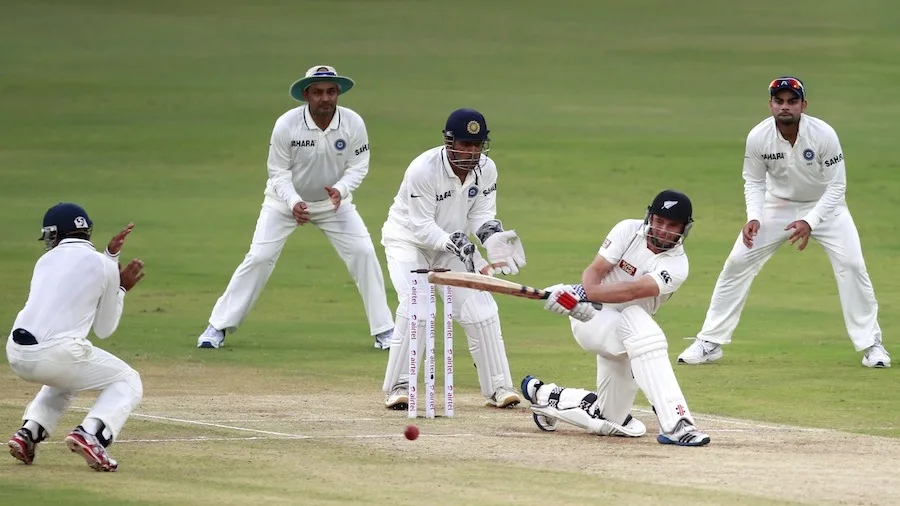
Featured image supplied by Behind The Stump: players in India and South Africa kits greeting each other on the field. The match and date have not been verified.
What is net run rate in cricket?
Net run rate, or NRR, compares a team’s scoring rate with its opponents’ scoring rate. A positive value means the team has scored faster overall; a negative value means it has conceded runs faster.
Run rate describes one scoring rate. NRR compares two. It is also different from an individual batter’s statistics, explained in our guide to batting average versus strike rate.
How to calculate net run rate: the formula
NRR = (total runs scored ÷ overs faced) − (total runs conceded ÷ overs bowled). Use the overs credited under the tournament’s rules, which can differ from the actual overs played.
The ICC Men’s T20 World Cup 2026 playing conditions, clause 16.10.7, set out the calculation and its adjustments. Check the relevant competition’s conditions when calculating an official table.
A simple net run rate calculation example
Imagine Team A makes 180/5 in 20 overs and restricts Team B to 150/7 in 20 overs. Neither side is all out, and rain does not affect the match.
Team A’s scoring rate is 180 ÷ 20 = 9.00. Its conceding rate is 150 ÷ 20 = 7.50. Subtracting gives 9.00 − 7.50 = +1.500 NRR. Team B’s figure for this match is −1.500.
These are single-match figures. A tournament table combines this performance with the other eligible matches rather than displaying only the latest result.
Why 19.3 overs is not 19.3 in a calculator
19.3 overs means 19 overs and three legal balls, equivalent to 19.5 overs for division. Cricket’s dot separates overs and balls; it is not a decimal point.
Convert the scorecard notation using completed overs + remaining balls ÷ 6. For example, 17.2 becomes 17 + 2/6. Keep the fraction or full precision until the final answer.
Suppose Team B chases 150 by reaching 151/4 in 18 overs. Its scoring rate is 151 ÷ 18 = 8.3889. If Team A used 20 overs, Team B’s single-match NRR is 8.3889 − 7.5 = +0.889, rounded. Our beginner’s guide to T20 cricket explains how a chase ends when the target is reached.
How an all-out innings affects NRR
An all-out innings uses the full allocated overs for NRR, even if the wickets fall earlier. In an uninterrupted 20-over match, 120 all out in 15 overs therefore contributes 120 ÷ 20 = 6.00, not 120 ÷ 15 = 8.00.
That distinction changes the arithmetic considerably. Treating the innings as 15 overs would wrongly reward the batting side for being dismissed early.
How to calculate tournament NRR across matches
Add the runs and credited overs first, then calculate the two rates. Do not take a simple average of individual match NRR figures.
Here is a two-match example with no rain adjustments or all-out innings. Team A scores 180 in 20 overs and concedes 150 in 20 in its first match. In its second, it concedes 160 in 20 and chases with 161 in 18.
Its combined figures are 341 runs scored in 38 overs and 310 conceded in 40 overs. Tournament NRR is therefore (341 ÷ 38) − (310 ÷ 40) = 8.9737 − 7.75 = +1.224.
Averaging the two match figures, +1.500 and approximately +0.944, gives about +1.222 instead. Even this small example shows why the method matters.
Why NRR matters for qualification
NRR can separate teams when the tournament’s earlier tie-break criteria leave them level. It does not replace points, and the order of tie-breakers depends on the event.
Before Netherlands faced Scotland in the 2023 World Cup Qualifier, the ICC’s qualification scenarios explained why Netherlands needed more than a narrow victory. Their winning margin or speed of chase also mattered. This is a historical example, not a current qualification equation.
A captain may therefore push for a quicker finish. Batting conditions can influence that decision too; our explanation of the dew factor in cricket covers one reason a chase can change as the evening progresses.
Rain, no-results and Super Overs
Under the cited ICC conditions, no-result matches and Super Over scores do not enter NRR. DLS results require prescribed adjustments to the first innings, so an ordinary scorecard-only calculation can be wrong. Use the official adjusted figures for those games.
FAQs: How to calculate net run rate in cricket
These questions cover the net run rate formula, NRR calculation examples and common mistakes when reading a cricket points table.
1. What does NRR stand for?
NRR stands for net run rate. It compares the rate at which a team scores with the rate at which it concedes runs.
2. Is net run rate the same as run rate?
No. Run rate is one innings’ or team’s runs per over. Net run rate subtracts the opposing scoring rate from the team’s own rate.
3. Does a faster chase help net run rate?
For the same runs scored and conceded, completing a chase in fewer overs improves the NRR contribution. The table still reflects the combined tournament figures.
4. Can a team win and still have negative NRR?
Yes. Earlier heavy defeats may leave its combined figure below zero after a win. One result does not erase the runs and overs from previous matches.
5. Should I average each match’s NRR?
No. Combine the eligible runs and credited overs before dividing. Averaging match figures gives different weight to innings of different lengths.
6. When should I round the calculation?
Keep full precision while converting balls and dividing totals. Round the final NRR for display, commonly to three decimal places, rather than rounding each intermediate step.