The World Test Championship points system awards 12 points for a win, six for a tie and four for a draw. Teams are ranked by the percentage of available points they earn, called PCT, after any over-rate deductions. The top two qualify for the final.
That percentage explains why the team with the most points is not always first. Countries play different numbers of Tests, so the table measures how much of their available reward they have collected.
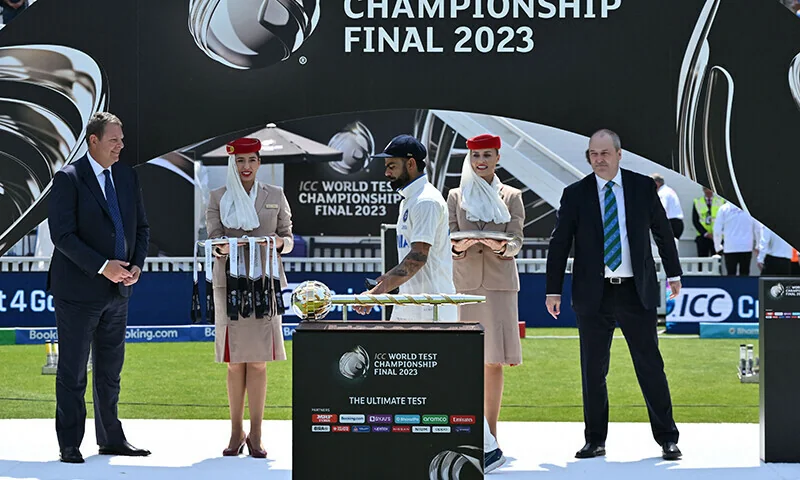
Archive photograph from the 2023 World Test Championship final, supplied by Behind The Stump. It illustrates the competition, not the current standings.
How many WTC points does each result earn?
For the 2025–27 round stage, every participating Test carries the same points allocation. The official ICC WTC standings confirm the scoring scale and qualification by points percentage.
| Result | Points earned | Share of 12 available |
|---|---|---|
| Win | 12 | 100% |
| Tie | 6 | 50% |
| Draw | 4 | 33.33% |
| Loss | 0 | 0% |
In a drawn match, each team receives four points; they do not split four between them. A tie gives each six. These are different results: a drawn Test has run out of time without a winner, while a tie requires completed innings with equal aggregate scores.
If those match outcomes are unfamiliar, our guide to Test cricket explains the innings structure. The WTC adds a championship table to the result of each eligible Test.
How is WTC points percentage calculated?
PCT = (points earned − penalty points) ÷ (Tests played × 12) × 100.
Consider a hypothetical team that plays six WTC Tests, winning three, drawing two and losing one. The wins bring 36 points and the draws eight, giving 44 points before penalties. Across six matches, the maximum available is 72.
Its PCT is therefore 44 ÷ 72 × 100 = 61.11%. This is an illustrative calculation, not a current national team record.
Now compare a second hypothetical team with 60 points from ten Tests. Although 60 is more than 44, its PCT is only 60 ÷ 120 × 100 = 50%. The first team ranks higher because it has earned a larger proportion of what was available.
Calculate with the full figures before rounding the displayed percentage. A table showing 61.11 does not mean a team has won 61.11% of its matches: draws, ties and deductions also affect PCT.
Why does the WTC use PCT instead of total points?
A simple points total would favour teams with more matches on their schedule. PCT allows results to be compared despite unequal Test counts. It does not make opponents, venues or schedules identical; it standardises the share of points earned.
Teams are scheduled to play six round-stage series, three at home and three away, with series containing between two and five Tests. A win is still worth 12 points in either a two-Test or five-Test series. There is no additional table bonus simply for winning the series.
This is also separate from ICC team rankings and ratings. The WTC table measures a particular championship cycle; the Test rankings are a different system.
How do slow over-rate deductions affect WTC points?
A team loses one championship point for each penalty over assessed after the relevant allowances and conditions. The ICC’s WTC playing conditions effective October 2026, clauses 12.9 and 16.11–16.12, govern the calculation. It is not simply a deduction for every over missing from a day’s scheduled play.
Return to the six-Test example. If that team incurs a two-point deduction, its points fall from 44 to 42. The denominator stays 72, so its PCT becomes 42 ÷ 72 × 100 = 58.33%.
That is a fall of 2.78 percentage points, not two percentage points. The size of the PCT change depends on how many points were available across the team’s matches. A championship-point penalty should not be confused with a separate match-fee fine.
How do teams qualify for the WTC final?
The first two teams at the end of the round stage qualify. There is no universal percentage that guarantees qualification in every cycle: the finishing positions depend on the other teams’ results as well.
If teams finish with identical PCT in 2025–27, the first tie-breaker is the number of series won. If that is equal, their away points percentage is compared. If they remain level, the higher ICC Men’s Test Team Ranking on 30 April 2027 decides their order.
A series win therefore matters as a tie-breaker even though it earns no separate bonus points. Our Test cricket rules guide explains declarations, follow-ons and draws, the match decisions that sit behind these championship results.
World Test Championship points system FAQs
These WTC points system questions clarify PCT, draws and the difference between older and current scoring rules.
1. Does every Test match count towards the WTC?
No. Only Tests designated as part of the championship round stage count towards this table. Being an official Test match does not automatically make it a WTC fixture.
2. Does a draw always lower a team’s PCT?
No. Before any new deductions, a draw moves the existing percentage towards 33.33%. It lowers a percentage above that level and raises one below it, because it adds four earned points and 12 available points.
3. Are away wins worth more points?
No. Home and away wins both earn 12. Away results can matter in the tie-breaker sequence, but they do not receive extra match points.
4. Does a WTC series still have 120 points available?
That describes the first cycle’s allocation, not the current system. Today, a two-Test series offers a team a maximum of 24 points, while a five-Test series offers 60.