A commentator says the captain has moved a fielder from slip to cover. The next ball produces an easy single, and suddenly that small change becomes part of the story. To understand why, you need to know where those positions are—and what each one is meant to do.
Cricket fielding positions describe where a fielder stands relative to the batter facing the ball. Slip, point and cover are on the off side; square leg and midwicket are on the leg side. Names such as deep, short, fine and wide refine the location. These are flexible areas, rather than fixed spots painted on the ground.
This guide starts with a right-handed batter. If you are still learning the match structures, our overview of Test, ODI and T20 cricket formats provides the wider context.
Cricket fielding positions diagram
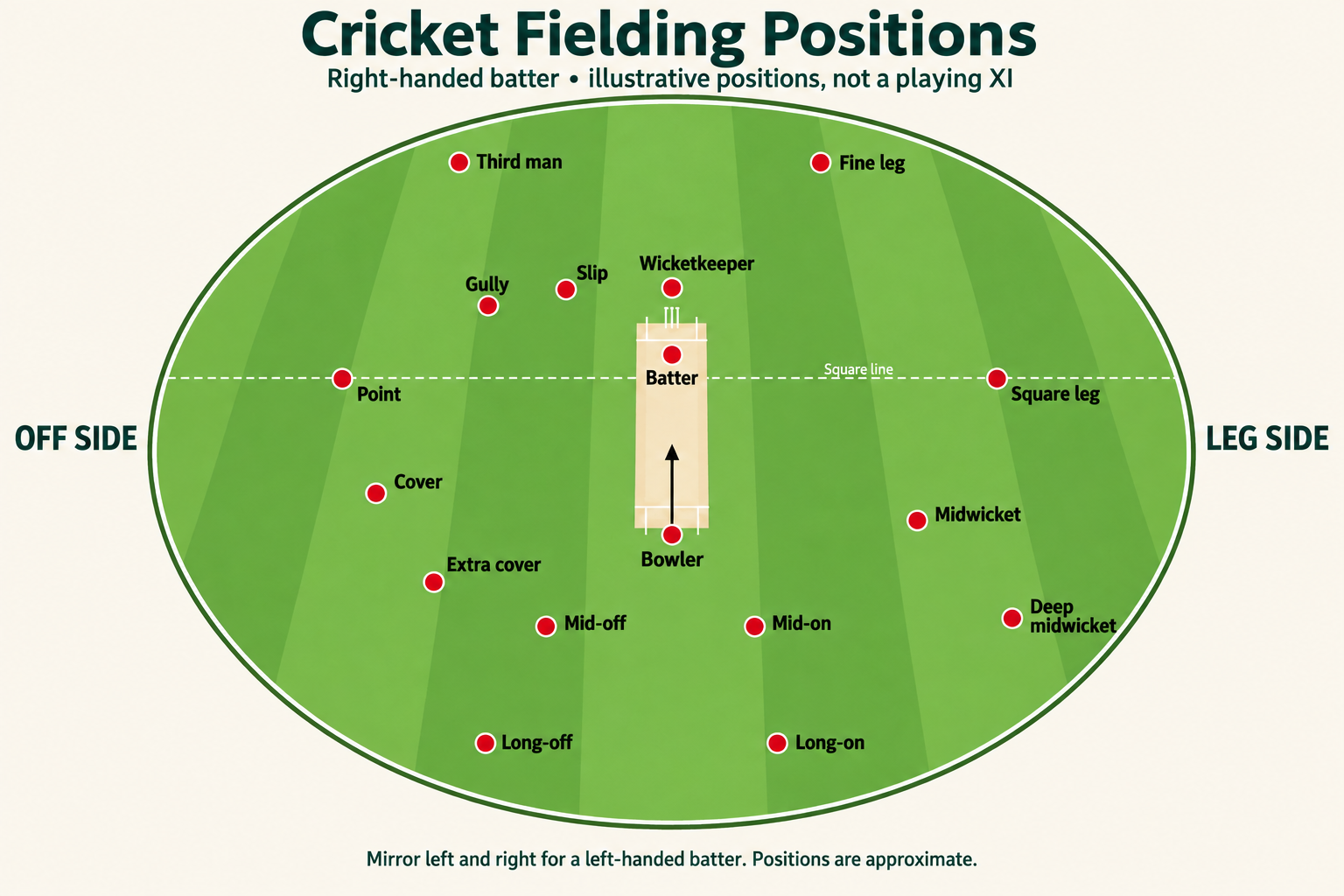
Read the diagram from the batter’s end: the wicketkeeper is behind the striker and the bowler is ahead. Point and square leg are roughly level with the striker. Cover and midwicket are in front of that line, while slip, third man and fine leg are behind it.
Off side and leg side: the starting point
Imagine a batter standing side-on in a normal batting stance. The side in front of their chest is the off side; the side behind their back is the leg side, also called the on side. These names belong to the batter’s orientation, not to the left or right edge of your television screen.
In our diagram, a right-handed batter faces the bowler towards the bottom of the image, so the off side is on the left. For a left-handed batter facing the same direction, the sides reverse. A fielder who was at cover may therefore need to cross the ground to remain at cover when the striker changes.
The main cricket fielding positions and their jobs
A standard fielding side has eleven players: the bowler, the wicketkeeper and nine other fielders. The captain chooses among the positions below according to the bowling plan and match situation.
| Position | Where it is | Typical purpose |
|---|---|---|
| Wicketkeeper | Behind the striker’s wicket | Collects balls that pass the batter; takes catches and completes stumpings. |
| Slip | Behind the batter on the off side, beside the keeper | Catches outside edges. First slip is nearest the keeper; further slips extend wider. |
| Gully | Behind square on the off side, wider than the slips | Catches wider edges and intercepts some shots played behind point. |
| Point | Roughly square of the batter on the off side | Stops cuts and square shots and helps restrict singles. |
| Cover | In front of square on the off side | Intercepts cover drives and other shots through the off-side gap. |
| Extra cover | Between cover and mid-off | Protects the straighter part of the cover region. |
| Mid-off | Near the bowler’s end, to the off side of the pitch | Stops relatively straight drives and challenges quick singles. |
| Mid-on | Near the bowler’s end, to the leg side of the pitch | Protects the corresponding straight region on the leg side. |
| Midwicket | In front of square on the leg side | Covers clips, pulls and drives through that region. |
| Square leg | Roughly square of the batter on the leg side | Covers square leg-side shots, including pulls and sweeps. |
| Fine leg | Behind square on the leg side, relatively close to the line of the pitch | Covers fine glances and deflections; often placed near the boundary. |
| Third man | Behind square on the off side, beyond the slip and gully region | Protects against edges and guided shots; often a boundary position. |
| Long-off | Near the boundary, roughly beyond mid-off | Protects against straight off-side hits and offers a catching option. |
| Long-on | Near the boundary, roughly beyond mid-on | Protects against straight leg-side hits and lofted drives. |
| Deep midwicket | Near the boundary beyond midwicket | Covers powerful leg-side hits, including pulls and slog sweeps. |
These are typical jobs, not guarantees about where a shot will travel. A batter can edge a drive to slip or mishit a pull towards mid-on. Fielders must respond to the ball, not just the name of their position.
Close catching: short leg and silly point
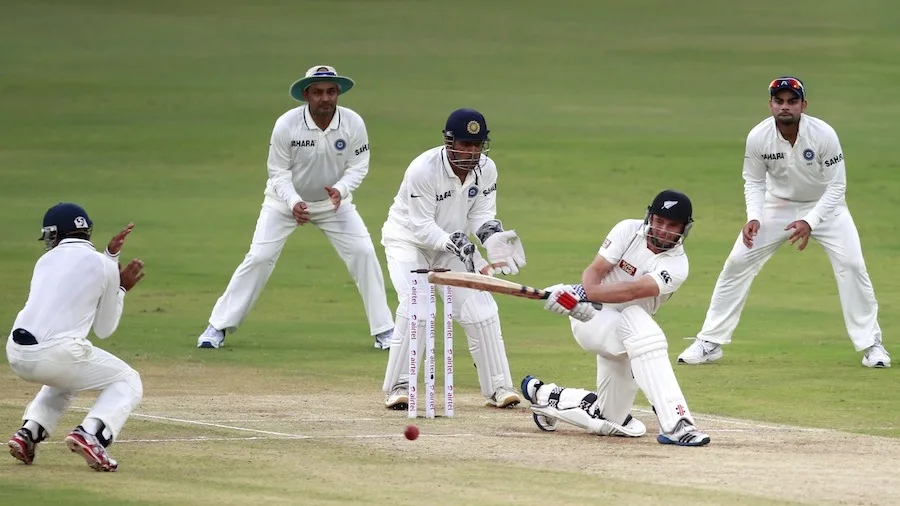
Two other useful names are short leg and silly point. Short leg stands close to the batter on the leg side, commonly looking for a bat-pad chance. Silly point is a very close off-side catching position, usually slightly in front of square. Both appear frequently when a spinner is trying to force a defensive mistake.
The wicketkeeper’s position has its own rules. For example, the keeper must remain wholly behind the wicket until the circumstances specified in MCC Law 27 on the wicketkeeper allow them to move forward. Standing up to spin and standing back to pace are tactical choices within those requirements.
What do deep, short, square and fine mean?
Learning the modifiers makes unfamiliar names much easier to decode:
- Deep: farther from the batter, generally towards the boundary. Deep cover protects the same broad direction as cover, but at greater distance.
- Short: closer to the batter than the usual position. Short third man is brought in from the deeper third-man area.
- Silly: extremely close to the batter, normally for a catching chance.
- Square: approximately at a right angle to the pitch through the striker’s position.
- Backward: moved behind that square line, towards the wicketkeeper’s end. Backward point is behind point.
- Forward: moved ahead of the square line, towards the bowler’s end.
- Fine: closer in angle to the line extending behind the striker’s wicket. Fine leg is finer than a squarer leg-side position.
- Wide: farther sideways from the line of the pitch compared with the usual placement. Wide long-on is less straight than long-on.
Distance and angle are separate ideas. A fielder can be both deep and fine, or short and backward. That is why a captain can make a meaningful adjustment without changing the broad name of the position.
How captains use fielding positions
1. Slips turn movement into a wicket-taking plan
Imagine a seam bowler repeatedly beating a batter’s outside edge. Adding a second slip gives the captain another catcher where an edge might travel. Removing that slip to strengthen cover may save runs, but leaves fewer catchers behind the bat.
The surface can influence that choice. Our guide to how cricket pitch types affect a match explains why bounce and movement matter more than simply calling a pitch green or dry.
2. A boundary fielder can change the batter’s decision
Suppose a spinner has long-on back but mid-off inside the circle. A batter may see a chance to hit over mid-off. That gap might be deliberate: the bowler could be trying to tempt a lofted shot against the turn or from an uncomfortable length. The field creates an invitation; the delivery must make that invitation risky.
3. Saving one can be different from saving four
With one run needed, a captain may bring fielders closer to stop a quick single. With five needed from the final ball, boundary protection becomes more valuable. Neither arrangement is automatically more attacking or more defensive in every situation—the score changes what the field needs to achieve.
Fielding positions vs fielding restrictions
A position name tells you where a player is standing. A fielding restriction tells you whether that arrangement is permitted. A captain might want long-on, long-off, deep cover and deep midwicket together, but the relevant powerplay restrictions may prevent it.
For the phase-by-phase limits, see our ODI vs T20 fielding restrictions guide. Check the applicable ICC playing conditions for the competition and format you are watching, especially when overs are reduced.
There is also a general leg-side limit: at the instant of delivery, no more than two fielders other than the wicketkeeper may be behind the popping crease on the leg side. That requirement comes from MCC Law 28 on the fielder. It is different from a limit on players outside the fielding circle.
How to read a field before the next ball
- Find the striker. Check whether the batter is right- or left-handed.
- Count the close catchers. Slips or a short leg can reveal where the captain expects a mistake.
- Look for the boundary protection. Notice which shots have cover and which gaps are available.
- Compare the field with the delivery. Does the bowler’s line and length actually suit the plan?
Try this over six deliveries rather than judging one ball in isolation. A fielder moving a few metres wider, followed by a change of bowling angle, may tell you more about the contest than the scoreboard does.
Frequently asked questions
How many fielding positions are there in cricket?
There is no single fixed total of named positions. Names describe areas, and modifiers create variations. A standard team still has only eleven players on the field, including the bowler and wicketkeeper; it cannot fill every position on a learning diagram.
What is the difference between point and cover?
Point is roughly square of the batter on the off side. Cover is farther in front of square, towards the bowler’s end. Point commonly deals with cuts; cover commonly deals with drives through the off side.
What is the difference between long-on and long-off?
Both are deep positions near the straight boundary at the bowler’s end. Long-on is on the leg side; long-off is on the off side.
Do positions change for a left-handed batter?
The names stay the same, but their sides reverse relative to a right-handed batter facing the same end. Captains may also change the whole plan rather than simply mirror the field.
Is the square-leg umpire a fielder?
No. The umpire may stand near square leg but is a match official. Do not count either umpire among the eleven fielding players.