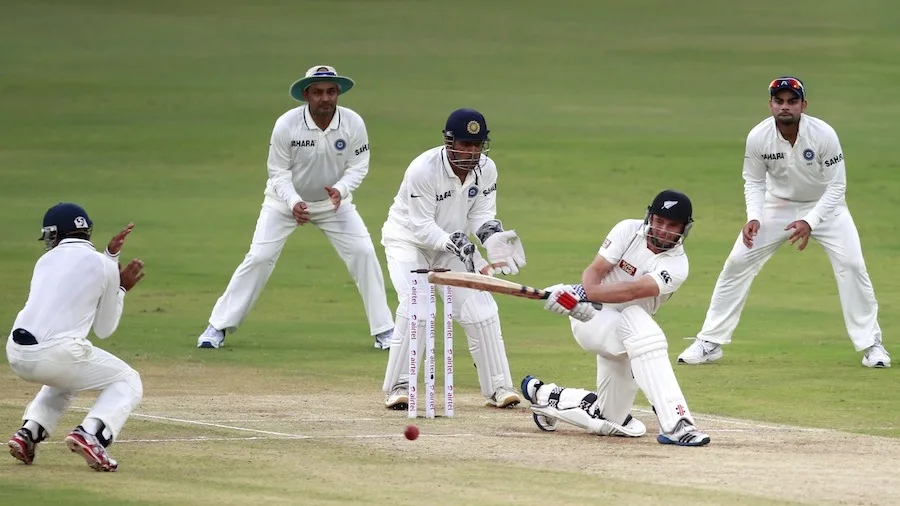

Test cricket is the international game’s long format, with each team allowed up to two innings. A match develops over several days, so the challenge is both to build a score and to leave enough time to force a result.
New to the different match types? Our overview of cricket formats puts Tests alongside ODI and T20 cricket.
How does a Test match work?
Imagine Team A scores 300 in its first innings and Team B replies with 250. Team A leads by 50. If Team A then scores 200 in its second innings, its combined total is 500, leaving Team B needing 251 in its second innings to win.
This invented example shows why a Test score cannot be read in isolation. A team on 100 might be building a first-innings total, recovering from a deficit, or approaching a winning target. Always check the innings number and the lead or runs required.
How long does Test cricket last?
Men’s Tests are normally scheduled for five days. A match can finish earlier when a result is achieved. Women’s Test scheduling can differ, so check the fixture’s playing conditions rather than assuming every Test has the same duration.
The scheduled days are not a promise of uninterrupted cricket. Rain, poor light and other stoppages can reduce the available play. That lost time can become a major part of the tactical contest.
What are a declaration and a draw?
A declaration is a captain’s decision to close an innings voluntarily. The captain may believe the lead is large enough and want more time to bowl at the opposition.
If time expires without a win or a tie, the match is drawn. A draw does not require equal scores. A team can be behind and still save the match by preventing the opposition from completing a win before the available time runs out.
For example, picture a captain deciding between another hour of batting and an extra hour of bowling. More runs offer protection; more time creates opportunities to take wickets. That trade-off helps explain why the scoreboard alone does not tell the whole story.
Why do batters sometimes leave the ball?
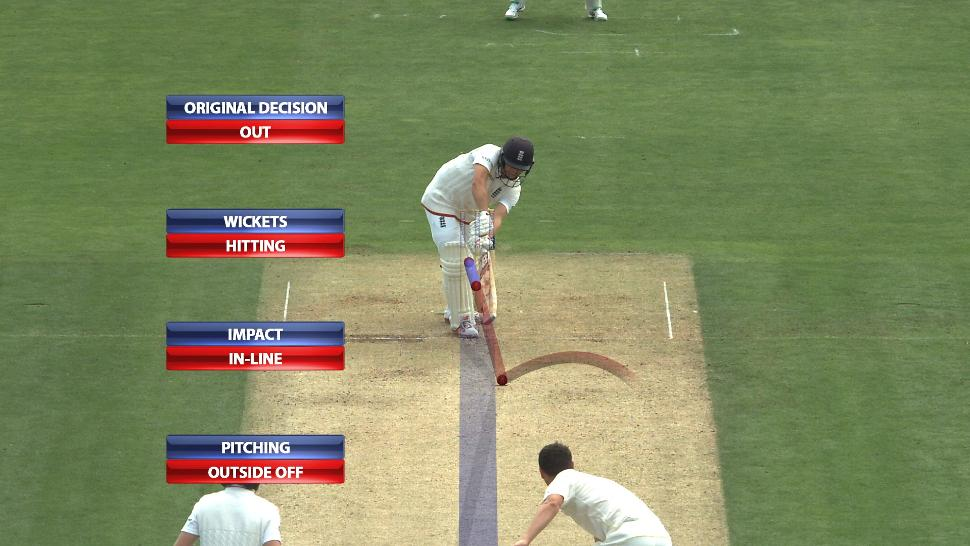
A delivery passing safely outside the stumps may not be worth the risk of an edge. Leaving it can be a deliberate choice, especially when the bowler is getting movement. The batter is judging which contests to accept.
Patience does not mean every Test innings is slow. A batter can attack loose deliveries, put pressure on a particular bowler or accelerate when the team needs time. The situation determines the approach.
What should a beginner watch?
Follow the lead or deficit, wickets remaining and time left. Then watch the smaller contest: is a bowler repeatedly testing the same area, and is the batter adjusting? A passage with few runs can still reveal who is gaining control.
To see how the same decisions change with an over limit, read our guides to ODI cricket and T20 cricket, or the practical Test, ODI and T20 comparison.
Rules reference: ICC playing conditions. Examples in this guide are illustrative; competition-specific conditions and reduced-over matches can differ.