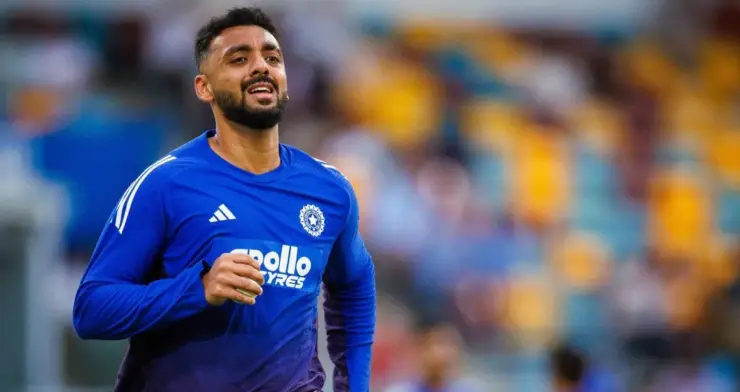
India’s injury list is becoming a serious concern at a time when every series should be helping the team build clarity for the 2027 ODI World Cup.
Jasprit Bumrah and Hardik Pandya have required careful workload management throughout their careers. Now, two more important white-ball options—Varun Chakravarthy and Harshit Rana—have suffered fresh setbacks soon after returning from previous injuries. The pattern raises a bigger question: can India keep its best talent available for the matches that matter most?
India’s injury list is getting harder to ignore
One isolated injury can be dismissed as bad luck. Several setbacks involving players who fill specialised roles are harder to ignore. Bumrah is India’s premier fast bowler, Hardik provides rare seam-bowling all-round value, Varun is a middle-overs wicket-taker, and Harshit offers pace and aggression. Losing even one can alter the balance of a major tournament squad.
Availability also affects selection beyond the injured player. When a first-choice bowler drops out, another player may be asked to cover an unfamiliar phase of the innings. A batting all-rounder may need to bowl more. A reserve may be rushed into a role before the team has properly tested him. Those compromises can become decisive in knockout matches.
India already faces difficult selection calls, as seen in the debates around Sanju Samson’s T20I form and Shreyas Iyer’s place in the T20 side. Recurring injuries make that planning even more complicated.
Varun Chakravarthy’s setback came just after his return
Varun had only recently worked his way back from a hamstring problem. His latest setback has been reported as a side strain, ruling him out of the remaining T20Is against Afghanistan and placing his next assignment in doubt. The Indian Express reported the fresh injury after his return to international action.
For a spinner whose effectiveness depends on repeatable mechanics, rhythm and control, a stop-start return is especially frustrating. Varun’s variations are most dangerous when he can bowl with confidence through the middle overs. Time away from match play does not simply reduce his fitness; it can also interrupt the competitive rhythm that makes his skill set so valuable.
Harshit Rana’s comeback has stalled again
Harshit was also making his way back after a hamstring injury when he suffered another problem during match simulation. The latest injury has been reported as a rectus femoris strain, affecting the front of the thigh. It ruled him out of the Afghanistan series and the Asian Games, according to The Indian Express.
This is another interrupted comeback for a young fast bowler still establishing himself at international level. In July, the BCCI had already announced replacements for injured Harshit and Varun. Their renewed absence shows why medical clearance is only one step in a successful return. A player must also tolerate full-speed training, match simulation and repeated game loads.
India has no shortage of emerging talent—the rise of players such as Vaibhav Suryavanshi has widened the selection conversation. Yet young fast bowlers need carefully staged workloads because their bodies are adapting to the demands of domestic cricket, franchise leagues and international schedules.
Why Bumrah and Hardik remain central to the workload debate
Bumrah and Hardik sit at the centre of every discussion about workload because India cannot easily replace what they do. Bumrah can control the new ball, break partnerships in the middle overs and close an innings at the death. Hardik gives the XI an extra pace option without weakening the batting.
Their injury histories have already taught India that availability must be planned, not assumed. That does not mean resting them from every bilateral series. It means deciding which matches matter most, measuring how their bodies respond and resisting the temptation to accelerate a return simply because an important fixture is approaching.
What India must fix before the 2027 World Cup
The 2027 World Cup in South Africa, Zimbabwe and Namibia will demand fast-bowling depth, athletic fielding and players who can recover quickly between matches. India’s planning should therefore focus on a few practical priorities:
- Build individual workload plans that account for international cricket, domestic matches, franchise tournaments, travel and training intensity.
- Treat return-to-play as a gradual process, with clear steps from rehabilitation to bowling at full pace, match simulation and competitive cricket.
- Develop genuine backups for specialist roles instead of waiting for an injury before testing alternatives.
- Improve communication between the national team, state associations and franchises so one medical plan follows the player across competitions.
- Use performance and recovery data to identify warning signs early, while recognising that data cannot eliminate every injury.
None of these measures guarantees a fully fit squad. Fast bowling places exceptional stress on the body, and injuries will always be part of elite sport. The aim is to reduce avoidable setbacks and prevent a minor problem from becoming a repeated cycle of rehabilitation and return.
Keeping talent available is now the real challenge
India’s depth is often described as its greatest advantage. That depth helps the team survive bilateral series, but World Cups are usually decided by the quality and balance of the best XI. A replacement may be talented without providing the same tactical option as the player who is missing.
Varun and Harshit’s latest setbacks should therefore be treated as more than two names added to an injury list. They are reminders that recovery timelines, training loads and comeback plans require the same attention as selection and tactics.
Talent is not India’s problem. Keeping that talent on the field might be.